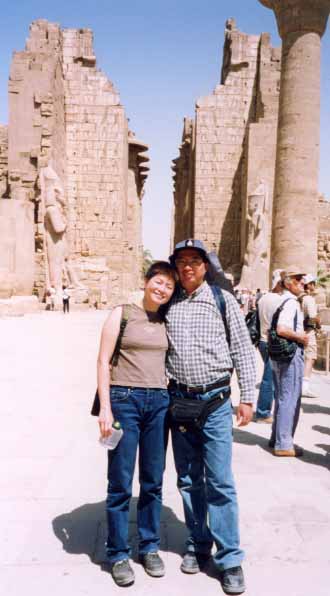
Egypt (Luxor)
While Luxor is not very famous, its monuments are far more spectacular than anything you can find at Giza.
Since you are using the best browser,
you can use the Menu button on the top right hand side
to navigate among these pages.
Journey to the South
After our trip to Giza, we rode an overnight train to Luxor.
Sidebar: What is so important about Luxor?
Luxor is in the middle of Egypt, 900 km South of Cairo.
On the train, we had a (tiny) bedroom for two, with a washing basin and a big mirror.
Dinner was served soon after we boarded the train in the evening, and breakfast arrived not long before we arrived, at 4:15 in the morning!
I finish everything served, but many of us tested the dinner and decided not to touch it.
I should have sold the cup noodles we brought with us at a high price, instead of just giving them away.
As for the breakfast, perhaps only the escort guide and myself had ate it.
After we arrived at Luxor, we picked up the local guide and started our journey in Upper Egypt.
Luxor is a bustling, modern city, known in ancient times as Thebes.
You don’t have to look far to see the astonishing monuments and temples of ancient Egyptian.
Valley of the Kings, Valley of the Queens and Temple of Karnak are just a few kilometres away from the city of Luxor.
continued...
Back to top
Thebes
Luxor is a name you seldom heard of in Egypt History.
Because it is a modern name of the town.
All the fame due for the city went under another name: Thebes.
Thebes covers Luxor and Karnak, two neighbouring cities of today.
The word Thebes came from the Greek name of the city, Thebai.
The name Thebai was in turn derived from the Egyptian word Apet, which was the name of the most important festival held each year at Luxor.
During the Old Kingdom (about 4636 — 4031 years ago), the capital is at Memphis in the Lower Egypt and Luxor was only an obscure little town known as Weset (meaning Scepter, symbol of sovereignty).
After the collapse of the Old Kingdom, the power of Weset increased gradually.
In the 11th Dynasty, the Theban prince Mentohotep reunified Egypt and founded the Middle Kingdom, which lasted only 200 years.
When the Hyksos invaded the Delta and brought the Middle Kingdom to an end, Thebes did not submit.
In 1580 BC, it is Ahmos, again from Thebes, who expelled the Hyksos and go on to reunify Egypt.
Thebes became capital of the New Kingdom.
Thebes extended over twenty-three miles of land and covered the cities Weset (now Luxor) and Newt (now Karnak, about 4 km North of Luxor).
Its god Amon became the supreme state god.
The position of Thebes and Amon was not challenged for the next five centuries except for about 18 years in the 18th Dynasty, when the heretic Pharaoh Akhenaten moved the capital to a newly found city (now called) El-Amarna dedicated to a new god Aten.
After his death, the nine-year old Tutankhamon succeeded him.
His advisors promptly abandon Aten and returned to Thebes as capital and Amon for worship.
continued...
Back to Journey to the South
Back to top
Thebes at its zenith
The first kings of the 19th Dynasty, Seti I and Ramses II (Ramses the Great, the Pharaoh mentioned in Exodus), set out to restore Egypt’s lost glory.
They reclaimed the lost territories abroad and continued the formidable building activity started in the 18th Dynasty.
Egypt expanded to the south (Nubia and Kush) and to the east (the Euphrate banks).
After Ramses II signed a peace treaty with the Hittites, the remainder of the 67-year long reign of Ramses II was peaceful and prosperous.
When Thebes rose to its zenith and held about a million inhabitants.
It had luxurious palaces, huge temples, large gardens, trading centers, foreign embassies…
It was the cosmopolitan city of the Egyptian Empire, the first city of the old world.
It was also known as the city of the one hundred gates.
Homer said that out of each of these 100 gates the Thebans could send forth 200 war chariots.
Ramses II outlived many of his older sons and died an age of 96 years and.
His 13th son succeeded him but Ramses III (and started the 20th Dynasty) was however unable to follow in his footsteps.
Dynastic disputes and chaos surfaced.
Ramses III was a capable ruler and had successfully repelled several foreign invasions, but his reign was also marked by corruption, social turmoil.
Shortly before he died, there was even a conspiracy against his life, something unconceivable in the previous dynasties.
Ramses III commissioned 14 people to judge over 40 people who were implicated in the conspiracy.
However he did not live long enough to see the end of the trial.
continued...
Back to Thebes
Back to Journey to the South
Back to top
The fall of Thebes
After the death of Ramses XI, Egypt's unity and stability started falling apart.
Final Pinedjm the great priest of Amon in Thebes, seized the throne and declared himself pharaoh of Upper-Egypt, while Lower-Egypt was in the hands of the administration of the Pharaoh.
Egypt was broken into fractions and the New Kingdom came to an end.
The divided Egypt weakened the Empire.
Finally the Assyrians destroyed Thebes in 665 BC leaving the glorious city in ruins.
Thebes remained forgotten during the periods of the Greek and Roman domination.
When the Arabs conquered Egypt in 639, they were impressed by the ruins of the palaces and temples in Weset and named it “al-Uqsuur” (meaning the palaces), known today as Luxor.
The Northern part of Thebes is now known as Karnak.
It was not until 1798 when Napoleons arrived in Egypt did Luxor get back its vitality: this time it became a tourist trap, a position it has kept ever since.
Back to Thebes at its zenith
Back to Journey to the South
Back to top
Valley of the Kings
First we rode the coach to the Valley of the Kings.
Crossing the Nile to the West Bank, we arrived at the great necropolis hidden behind the Theban Hills.
Far away from the Nile and humidity, hundreds of rocky tombs are among the mountains: King’s Valley, Queen’s Valley, mortuary temples, Nobles Tombs and workers tombs.
After arriving at the Valley of the Kings, we changed to a small train on (rubber) tires.
It took us along a carriage road that largely follows the old tracks of the funeral procession, and carried us to the valley entrance (that is, where you buy your tickets).
The Valley of the Kings is called Biban el-Muluk, which means Gates of the Kings.
Dug deeply in the mountain rocks are the tombs of the pharaohs from 18th to 20th Dynasties.
Its history started with the unexpected decision of Tuthmosis I to separate his tomb from the burial temple.
Moreover, he gave orders to bury his body not in a luxurious monument but in a secret inaccessible place.
His decision rudely interrupted a millenium old tradition of pyramids and mortuary temples.
And he did it with a very good reason: while disturbing an imperial tomb was unthinkable during the Old Kingdom, it had slowly become a common place practice.
So Tuthmosis I looked for more privacy.
continue
Back to Journey to the South
Back to top
The New Necropolis
King’s Valley was chosen as the burial place for several reasons.
The Valley is not far from the banks of Nile, so transportation is not too difficult.
Yet it is shielded by the hills so it is not visible from the Nile, nor affected by the humid air from the river.
The valley is small, surrounded by steep cliffs, and easily guarded.
The local limestone, cut millions of years ago by torrential rains to form the valley, is of good quality.
And towering above the valley is a peaked mountain, el-Qurn ("the horn" in Arabic, now called the Theban Crown), whose shape may have reminded the ancient Egyptians of a pyramid, the cult symbol of the sun-god Re.
Towards the end of the New Kingdom, the location was no longer a secret.
The tomb workers and their descendants lived in a village of growing population, and these people took up the profession of tomb robbing.
False walls, deep pits and other traps were used in tombs to guard against unwelcome guests, but it turns out that they are not as effective as in the pyramids.
Pyramids are built with quarry rocks (and later with unfired bricks), so you can place a rock in the middle of a corridor and pretend that it ends there.
Tombs at the Valley of the Kings are carved from the limestone rocks.
You can still erect wall but anybody can tell that it is not the original bed rock.
In the 20th Dynasty, the tomb of Ramses III was robbed thrice.
As a result, the priests of Amon decided to secretly dig a new hiding place for the pharaohs.
It is a large cave deep inside Mount Deir el-Bahari, accessed via a long corridor under a twelve metre deep well.
At night by torch light, as furtive as tomb raiders, they removed 40 Pharaohs from their sarcophaghi in the valley and assembled their mummies in the secret cave.
These mummies finally can rest undisturbed in the heart of the mountain for three thousand years, until a young tomb robber Ahmed Abd el Rasul found the secret place in 1875.
continue
Back to Valley of the Kings
Back to top
Into the Tombs
There are 62 tombs in the Valley of the Kings, ranging from unfinished one-room pits to a tomb with over 110 chambers and corridors.
Most were found already plundered; while a few, like the tomb of Tutankhamon (KV 62) contained thousands of precious artifacts.
The local guide took us to three tombs at the valley.
The first one is the tomb of Ramses IV (more about KV2: tombs are numbered by sequence they were discovered, and this one is the second among the 62 found tombs).
It is near the entrance of the valley, and has been open since antiquity.
Three white corridors descend to the sarcophagus chamber.
The lid of the pink granite sarcophagus is decorated with Isis and Nephthys.
There are hundreds of Greek, Latin and Coptic graffiti documenting visits during the Classical and Coptic Periods.
The tomb was even used as a residence during the Coptic period.
The tomb walls bear brightly colored paintings drawn on raised relief (they are carved and then painted, not just drawn on a flat wall) and inscriptions showing the journey of the dead to the underworld and his judgment.
Then she took us to the tomb of Ramses IV (more about KV6), also of the 20th Dynasty.
Two sets of steps lead down to the tomb door that is decorated with the Pharaoh worshipping the solar disc.
Isis and Nephthys stand behind him on either side.
Three corridors lead into an antechamber that opens into a pillared hall.
The passage beyond that leads to the sarcophagus chamber.
The kingdom was already suffering internal disorder and famines, and his tomb is not as beautiful as Ramses IV.
![]() After visiting two tombs from the 20th Dynasty, we went to an older tomb from the 18th Dynasty — tomb of Amenophis II (KV35).
Amenophis II, also known as Amenhotep II, is son of Tuthmosis III and grandson of Hatshepsut.
Tombs of the 18th Dynasty are not as colorful and paintings used primarily the black color.
The drawings are less delicate and contrasts sharply with the detailed pictures of the later times.
After visiting two tombs from the 20th Dynasty, we went to an older tomb from the 18th Dynasty — tomb of Amenophis II (KV35).
Amenophis II, also known as Amenhotep II, is son of Tuthmosis III and grandson of Hatshepsut.
Tombs of the 18th Dynasty are not as colorful and paintings used primarily the black color.
The drawings are less delicate and contrasts sharply with the detailed pictures of the later times.
continue
Back to The New Necropolis
Back to top
Into The Tomb of Tutankhamon
After visiting three tombs, we took a little rest under a shelter to hide ourselves from the morning sun of Luxor.
Fortunately, it was a cool day and the temperature is merely 39 degrees celsius.
It could have been 50 degrees!
Then we buy an additional ticket (more than 10 usd per head, not included in the tour package) to visit the most famous tomb of the valley.
It is, of course, the tomb of Tutankhamon (layout of KV62).
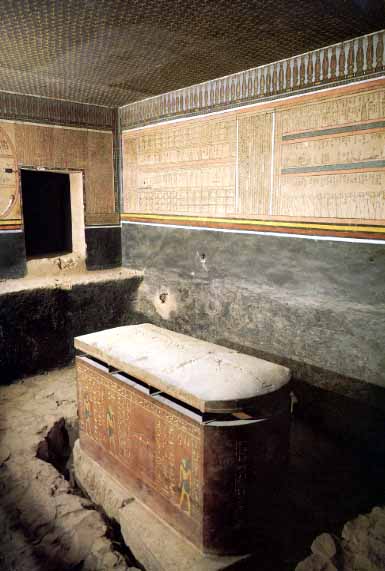
![]() Inside the tomb, we can see the mummy of Tutankhamon.
He is sleeping inside his quartzite sarcophagus, and is the only pharaoh still sleeping inside the King’s Valley.
Inside the tomb, we can see the mummy of Tutankhamon.
He is sleeping inside his quartzite sarcophagus, and is the only pharaoh still sleeping inside the King’s Valley.
Besides the brightly colored paintings, we also noticed the dark dots all over the walls.
You can clearly see the dots in the photo.
We didn’t find out what they really are until we came across a TV programme a few months later.
They are bateria, three thousands years of age.
Tutankhamon is the only tomb that stayed closed in all these millenia, and the only tomb with so much bacteria waiting to exercise its “Curse of Pharaoh” on us.
Since the tomb is opened to public, several tourists had been seriously sick (and a few died) after visiting KV62.
No wonder why the two guides did not follow us into the tomb.
Fortunately nothing fell upon us.
continued...
Back to Into the Tombs
Back to top
Deir el-Bahari
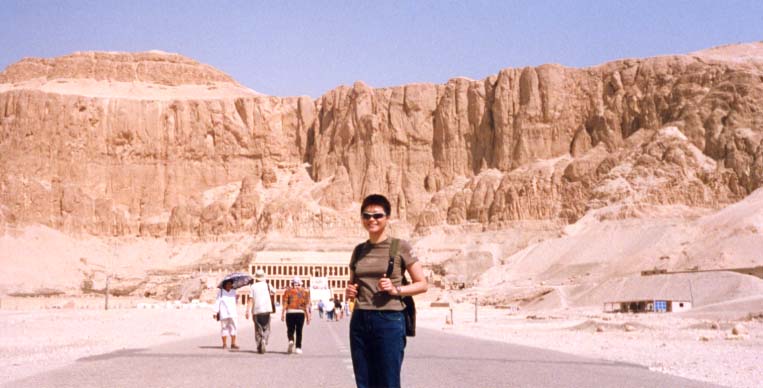
Then we leave the King’s Valley and proceed to Deir el-Bahari, to the most dramatically situated temple of the world: the mortuary temple of Hatshepsut.
Sidebar: Who is Hatshepsut?
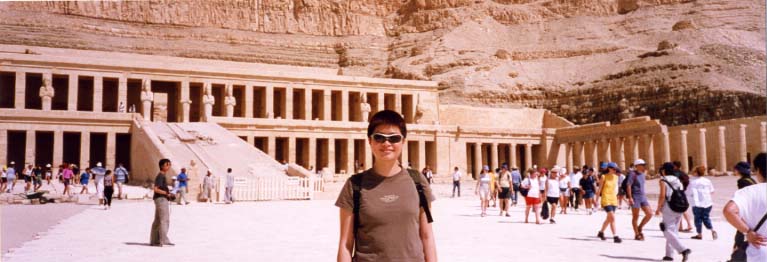
![]() Hatshepsut commissioned a monument to be built in honour of her father Tuthmosis I and for herself.
The temple faces eastwards and has a series of vast terraces continuing ochre-coloured mountain.
It is a natural amphitheater containing the mortuary temples of Mentuhetep II (11th Dynasty), Hatshepsut herself, Tuthmosis I (her father), Tuthmosis II (her husband) and Tuthmosis III (her step-son).
This temple at Deir el Bahari was consecrated to the goddess Hathor, and was built to perform the rites of the other world.
Hatshepsut commissioned a monument to be built in honour of her father Tuthmosis I and for herself.
The temple faces eastwards and has a series of vast terraces continuing ochre-coloured mountain.
It is a natural amphitheater containing the mortuary temples of Mentuhetep II (11th Dynasty), Hatshepsut herself, Tuthmosis I (her father), Tuthmosis II (her husband) and Tuthmosis III (her step-son).
This temple at Deir el Bahari was consecrated to the goddess Hathor, and was built to perform the rites of the other world.
Her tomb was originally planned to be located inside her Mortuary Temple.
However, the tomb builders encountered low-quality rock and had to change the plan.
As a result, she was buried in KV 20 in the Valley of the Kings (not the Valley of the Queens!).
It is 500m from the Deir el-Bahari, just on the other side of the Theban crown.
After the 18th Dynasty, the temple was abandoned.
In the 7th century BC the Copts used it as a monastery.
It was thanks to the insertion of the monastery in the pharaoh’s temple that the latter was preserved.
And the present name Deir el-Bahari actually means “the Northern Monastery” in Arabic.
continued...
Back to Into the Tomb of Tutankhamon
Back to top
Hatshepsut
Fifth ruler of the 18th Dynasty, this remarkable woman ruled Egypt for 15 years, the only she-pharaoh.
There are several female rulers in the history of Egypt, and only one is longer than hers; and it is Cleopatra the VI, queen of Egypt of the 32nd Dynasty, who ruled 21 years.
Most important, Hatshepsut is the only female ruler who ruled in the capacity of a pharaoh, wearing the pharaoh costume including the head dress, the false beard and the skirt, and had her name appearing inside a cartouche.
Hatshepsut was the daughter of Tuthmosis I (the first pharaoh buried at the Valley of the Kings) and Queen Ahmose of the 18th Dynasty.
Among the 6 offsprints of the great wife of Tuthmosis I, only Hatshepsut outlived her father.
As was common in royal families, she married her half-brother Tuthmosis II.
Tuthmosis II had a son, Tuthmosis III, by a minor wife.
When Tuthmosis II died in 1479 BC, the heir Tuthmosis III was still young and Hatshepsut became the regent.
They ruled jointly until 1473 BC when she declared herself pharaoh.
Dressed in man’s attire, Hatshepsut administered affairs of the nation, with the full support of the high priest of Amon and other officials.
When she built her magnificent temple at Deir el Bahari in Thebes she made reliefs of her divine birth as the daughter of Amon.
Like her father, she was a successful pharaoh and brought the long sought stability and properity to Egypt.
After her death, Tuthmosis III reclaimed the throne.
Later, the memory of her success faded, and a persecution of the existence of a she-pharaoh followed.
Her name was cut from monuments.
Her shrines, statues and reliefs mutilated.
It is fortunate that her obelisks continue to stand in Karnak.
Back to Deir el-Bahari
Back to top
Design of the temple
Thebes of the early 18th Dynasty was a genuinely creative period in architecture.
Yet the terraced Temple of Hatshepsut built on a cliff valley surpassed all others in originality and boldness of conception.
It is a master piece by Senmut, the favorite architect of Hatshepsut.
The monument is comparable to none other than the Giza Pyramids built by Imhotep of the Old Kingdom.
The most famous and well-preserved monument at Deir el-Bahari is the Temple of Hatshepsut called in antiquity Djeser-djeseru, meaning “the most magnificent of the magnificent”.
The temple is unique and avant-garde in Egyptian architecture.
The complex of the mortuary temple of Hatshepsut is a remarkable example of the aesthetic adaptation of a man-made structure into the natural environment.
It also showed influences from 12th Dynasty architecture of the Upper Egyptian nomarchs' tombs, with their numerous terraces clinging to the cliffs.
The original plan of the Temple was different from the plan of the final structure.
Tuthmosis II, the predecessor and husband of Hatshepsut, initiated the construction of the Temple on what is now known as the Upper Terrace.
Tuthmosis II died before the completion of his Temple.
Hatshepsut took over the project and drastically modified the plan.
She rebuilt the walls of the existing structure to fit the new plan, and extended the structure to the north and east.
continued...
Back to Deir el-Bahari
Back to top
A closer look
The Mortuary Temple consists of a series of three terraces of increasing height connected by ramps.
The first terrace is enclosed on the far side by a portico consisting of 22 pillars and flanked by two Osiris pillers.
The porticoes have celebrated reliefs depicting the transportation of obelisks by barge from Aswan to the Temple of Karnak, and the divine birth and coronation of Hatshepsut.
Central ramps lead to the second terrace, 8m high from first terrace, and buttressing walls are faced with colonnades of square pillars.
![]() Reliefs on the south side of the second terrace show the expedition of Hatchepsut by way of the Red Sea to Punt (modern Somalia), the land of incense.
On the south side of the Middle Colonnade is a Shrine of Hathor, and on the North side is a Shrine of Anubis.
The second ramp leads to the uppermost terrace.
Reliefs on the south side of the second terrace show the expedition of Hatchepsut by way of the Red Sea to Punt (modern Somalia), the land of incense.
On the south side of the Middle Colonnade is a Shrine of Hathor, and on the North side is a Shrine of Anubis.
The second ramp leads to the uppermost terrace.
The Upper Colonnade consists of a row of Osirid pillars flanked by colossi of Hatshepsut.
Throughout the temple, statues and sphinxes of the queen proliferated.
Many of them have been reconstructed from the smashed fragments found by the excavators.
continued...
Back to Design of the temple
Back to top
Colossi of Memnon
After our visit to Deir el-Bahari, we returned to the city.
On the return trip, we arrived at a pair of sitting statues.
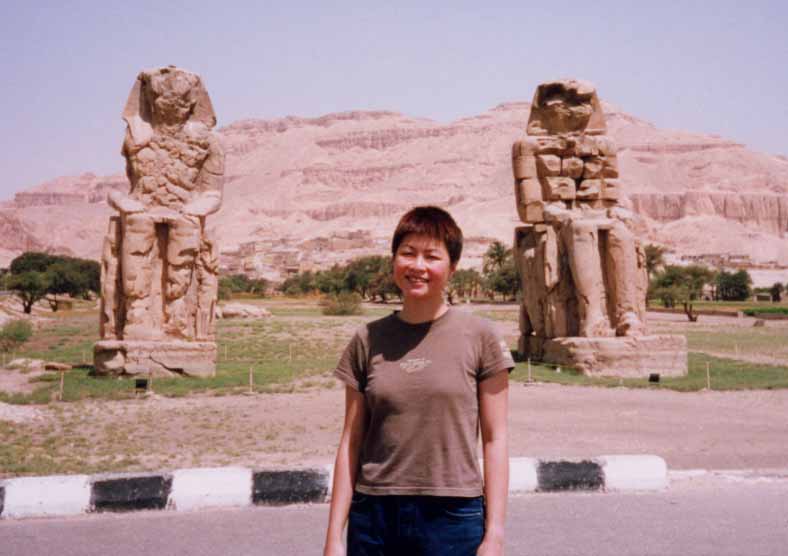
![]() The Colossi of Memnon are all that remains of the Mortuary Temple of Amenophis III of the 18th Dynasty.
They are a pair of monolithic statues that represent the pharaoh and his ka (his spiritual double).
They are made of quartzite sandstone brought from Edfu, 100 km upstream on the Nile.
The statues portray the pharaoh seated on his throne with his hands resting on his knees.
Their feet measure two metres long and one metres wide, and the statues are over twenty metres of height.
According to a stele found by archaeologists, beyond them used to be a pylon (a ceremonial gateway) marking the entrance to the temple, but little survives except the twin seated statues of the pharaoh.
The Colossi of Memnon are all that remains of the Mortuary Temple of Amenophis III of the 18th Dynasty.
They are a pair of monolithic statues that represent the pharaoh and his ka (his spiritual double).
They are made of quartzite sandstone brought from Edfu, 100 km upstream on the Nile.
The statues portray the pharaoh seated on his throne with his hands resting on his knees.
Their feet measure two metres long and one metres wide, and the statues are over twenty metres of height.
According to a stele found by archaeologists, beyond them used to be a pylon (a ceremonial gateway) marking the entrance to the temple, but little survives except the twin seated statues of the pharaoh.
It was said that after an earthquake in 27 BC, an enormous crack opened up from the top to the middle of the Northern statue.
However, it is not too trust-worthy because earthquakes were never heard of in Egypt before or after.
Anyway, after the Northern statue is cracked, it sang a sad harmonious song every morning at daybreak.
The statues were called mei-amon (beloved of Amon) in Egyptian.
Why is it now known as Colossi of Memnon?
Who is Memnon?
continued...
Back to Design of the temple
Back to top
Memnon
Interestingly, Memnon is not an Egyptian.
Son of Tithonus and Eos (goddess of dawn), he was the Prince of Ethiopia and was famed for his beauty.
He led his people to fight against the Greeks who were besieging Troy.
During that battle he performed many heroic feats.
He met Achilles in combat.
As they were fighting, both the heroes’ mothers petitioned Zeus to spare their sons.
Zeus, after checking the outcome in the golden balance which weighed out life and death, announced that it was the fate Memnon to die at the hands of Achilles.
Eos anxiously sped to Troy but found that her son was already dead.
Eos in tears beseeched Zeus to resuscitate her son at least once a day.
Every morning, while Eos was caressing her son with her rays, he replied to his mother disconsolately by wailing in a musical murmur.
It is because of the sound the statue made every morning that the Greeks called them Colossi of Memnon.
The Greek and Latin graffiti that cover its legs and torso speak of its popularity for ancient tourists.
Actually the sounds were produced from the vibrations in the broken surfaces when the statues, having chilled by the cold of the night, is heated up by first rays of the sun.
After repairs made to it in the 3rd century, however, the sounds were no longer heard.
continued...
Back to Colossi of Memnon
Back to top
Temple of Karnak
After our stop at the Colossi of Memnon, our coach went East to cross the Nile and go back to the East bank.
While all pyramids, tombs, and mortuary temples are on the West bank (the side where sun sets, City of the Dead), all temples of god are on the East bank (the side where sun rises, City of the Living).
The couah brought us to Karnak, a village about three kilometres North of Luxor, to visit the greatest temple ever built: the Temple of Karnak.
The city of Karnak is on the Northern part of Thebes.
After Arab conquered Egypt, the city is called al-Karnak, meaning the fort.
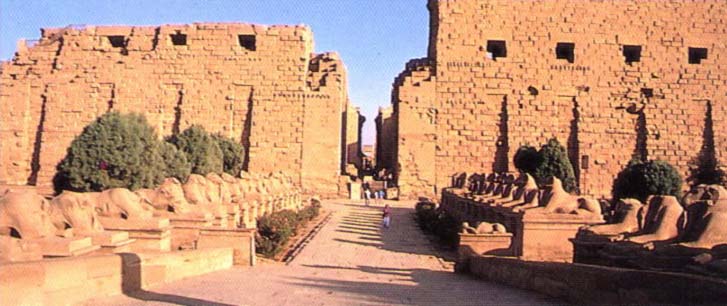
![]() The picture on the left shows the Sphinx Avenue leading to the First Pylon dating to the 30thth Dynasty.
A pylon is a large sloping wall found at the entrance to temples, usually consisting of two massive towers built in a trapezoid shape that flank the portal
The picture on the left shows the Sphinx Avenue leading to the First Pylon dating to the 30thth Dynasty.
A pylon is a large sloping wall found at the entrance to temples, usually consisting of two massive towers built in a trapezoid shape that flank the portal
The Karnak Temple is is overwhelming in its size and beauty, with four courtyards, ten pylons, a sacred lake and many buildings.
The whole size of the temple is almost half that of the Manhattan Island.
The area of the sacred enclosure of Amon alone is 61 acres and would hold ten average European cathedrals with ease.
The great temple at the heart of Karnak is so big that big cathedrals like St Peter’s, Milan and Notre Dame de Paris could be lost within its walls.
The Hypostyle hall of 6,300 square metres is still the largest room in any religious building in the world.
In short, Karnak Temple is the largest religious edifice in the world, and will take your breath away.
continued...
Back to Colossi of Memnon
Back to top
The Temple
The Karnak Temple was called Ipet-isut (meaning “most select of places”) in ancient Egypt.
Karnak is only the name of the modern village.
Luxor and Karnak were parts of the ancient city of Thebes, capital of the Middle and New Kingdoms.
This temple was the spiritual and cultural centre of the whole Egypt, dedicated to Amon-Ra.
Amon was an insignificant local god until the 12th Dynasty when Thebes became the capital of Egypt.
In ancent times wars were not fought between countries but were considered as contests between gods.
Amon and its people grew in strength, and in the New Kingdom, Amon rose to become the first supreme god of the known world.
Amon was unified with Ra and was hailed as God of gods.
The construction of Karnak Temple began in the Middle Kingdom when the capital is moved to Thebes.
It was largely completed during the New Kingdom 1600 years after it was started, but some additions were made as late as the Roman Era (c. 30 BC).
Virtually every ruler of the Middle and New Kingdoms contributed to the temple by extending the temple or adding halls and chapels.
Because of its architectural complexity, it serves as a base to study the stylistic evolution in Ancient Egypt, and in particular that of the New Kingdom.
For the largely uneducated ancient Egyptian population this could only have been the place of the gods.
It is the mother of all religious buildings, the largest ever made and a place of pilgrimage for nearly 4,000 years.
The pilgrims today are however, mainly tourists.
continued...
Back to Temple of Karnak
Back to top
Avenue of Sphinxes
While I do include several pictures, they are doing injustice to the immensity of Karnak.
You have to see it in the flesh to really experience it.
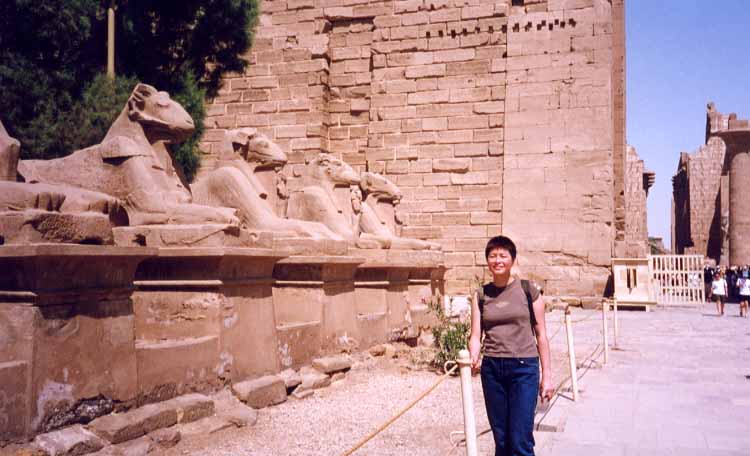
![]() The avenue has sphinxes on both sides and leads to the first and largest pylon.
These sphinxes have a ram head.
It is because the Middle and New Kingdom belonged to the Age of Aries the ram (you do not know what is Age of Aries? go back to read about precession when I was talking about the Sphinx).
The ram-headed sphinxes are sacred to Amon and represent the god that protected the pharaoh.
In this close up picture you can see the sphinx protecting Ramses II.
The avenue has sphinxes on both sides and leads to the first and largest pylon.
These sphinxes have a ram head.
It is because the Middle and New Kingdom belonged to the Age of Aries the ram (you do not know what is Age of Aries? go back to read about precession when I was talking about the Sphinx).
The ram-headed sphinxes are sacred to Amon and represent the god that protected the pharaoh.
In this close up picture you can see the sphinx protecting Ramses II.
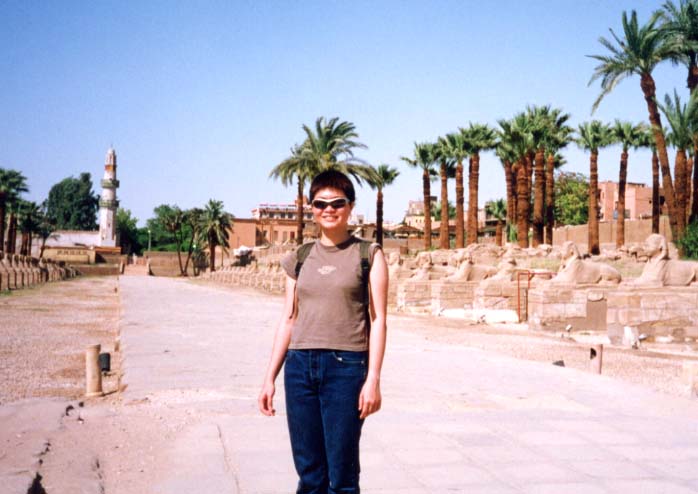
![]() If we turn around, we would notice that the Avenue of Sphinxes goes way back.
Actually the stone-paved processional avenue flanked by sphinxes goes all the way to the Nile.
However, the avenue had not been reconstructed completely.
If we turn around, we would notice that the Avenue of Sphinxes goes way back.
Actually the stone-paved processional avenue flanked by sphinxes goes all the way to the Nile.
However, the avenue had not been reconstructed completely.
continued...
Back to The Temple
Back to top
Ethiopian Courtyard
After we passed through the First Pylon, we arrived at the first court, known as the Ethiopian Courtyard.
It is constructed in the Late Period (21st to 26th Dynasties).
During this period, there were Ethiopian Kings from Napata struggling with the Assyrians for control of Egypt.
In this same period, the Libyans, Kushites and some Egyptian families, ascended to the throne.
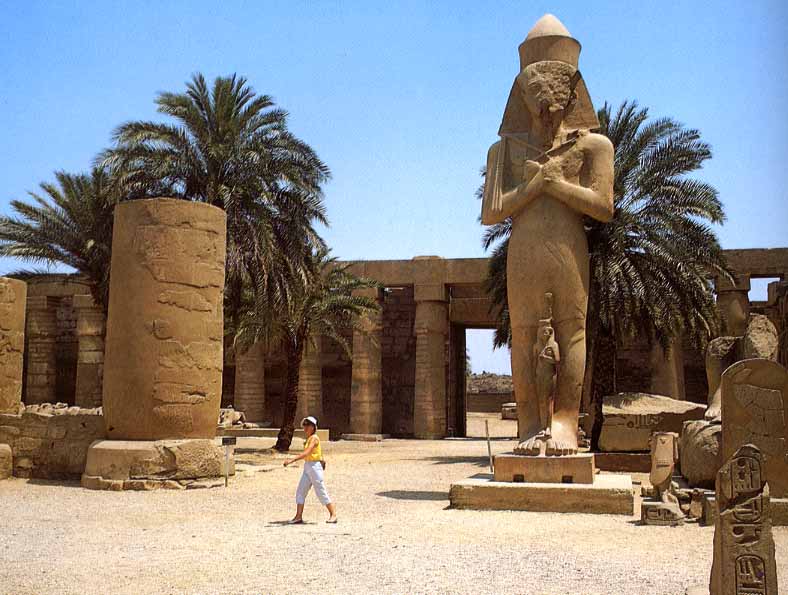
![]() In the center of the Ethiopian Courtyard is the Colossus of Pinedjem, with a statue of his queen portrayed between the legs of the giant statue.
Pinedjem is the High Priest of Amon in Thebes who declared himself pharaoh.
He put an end to the New Kingdom and was the first pharaoh of the 21st Dynasty.
In the center of the Ethiopian Courtyard is the Colossus of Pinedjem, with a statue of his queen portrayed between the legs of the giant statue.
Pinedjem is the High Priest of Amon in Thebes who declared himself pharaoh.
He put an end to the New Kingdom and was the first pharaoh of the 21st Dynasty.
![]() Next to the statues is a broken column.
It was part of the Kiosk of Tahaga, a once gigantic pavilion of the Ethiopian King Taharga.
Now only a single column remains intact.
It is 21 metres high, with an open papyrus top.
Next to the statues is a broken column.
It was part of the Kiosk of Tahaga, a once gigantic pavilion of the Ethiopian King Taharga.
Now only a single column remains intact.
It is 21 metres high, with an open papyrus top.
On the East side of the Ethiopian Court is the Second Pylon built by Ramses II.
Two statues of Ramses II in front of the Second Pylon.
On the right hand side, you can see the last standing column of the Kiosk of Tahaga.
Beyond the Second Pylon, the columns of the Great Hypostyle Hall can be seen.
continued...
Back to Avenue of Sphinxes
Back to top
Hypostyle Hall
The Hypostyle Hall is the most prodigious hall ever erected and is considered to be one of the world’s greatest architectural masterpieces.
It is doubtful if any building yet designed has attained its dramatic power.
The word hypostyle came from Greek and means “resting on columns”.
The Hypostyle Hall is a man-made stone forest separating the temple’s open court from the sancturay.
Festivals and ceremonies took place in the open court outside; while only pharaohs and priests were admitted to the sanctuary.
The processional path through the Hypostyle Hall was a preparatory passage from this world to the next.
![]() The hall measures 120 metres wide by 53 metres long.
It is a stone bastion of 134 columns.
A central row of 12 columns defining the processional aisle on the east-west axis are 21 metres in height, 10 meters in circumference, and have open papyrus capitals.
At their tops, the open papyrus-shaped capitals head has a circumference of about 15 metres.
The other 122 columns in the side aisles are 13 meters in height, 8.4 meters in circumference, and have closed papyrus-bud capitals.
All the columns, walls and ceiling have reliefs and were painted in bright colors.
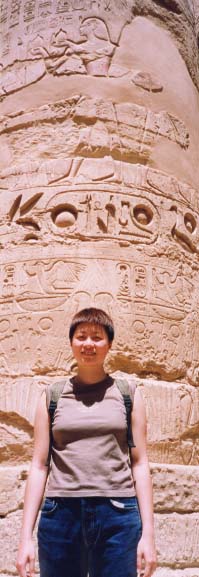
Look at the column behind Irene to see how big the columns are.
The hall measures 120 metres wide by 53 metres long.
It is a stone bastion of 134 columns.
A central row of 12 columns defining the processional aisle on the east-west axis are 21 metres in height, 10 meters in circumference, and have open papyrus capitals.
At their tops, the open papyrus-shaped capitals head has a circumference of about 15 metres.
The other 122 columns in the side aisles are 13 meters in height, 8.4 meters in circumference, and have closed papyrus-bud capitals.
All the columns, walls and ceiling have reliefs and were painted in bright colors.
Look at the column behind Irene to see how big the columns are.
continued...
Back to Ethiopian Courtyard
Back to top
Lighting in the Hypostyle Hall
![]() This picture was taken from the ruins on the South of the Hypostyle Hall.
You can clearly see the columns. Remember that the whole of this hall was originally roofed with stone slabs.
Only narrow rays of light enter through little openings cut into the ceiling.
The difference in height between the central and the side aisle columns was used to provide some additional natural light through the clerestory.
Clerestoryis a large open work window in sandstone with vertical stone slats that you can see in the picture.
It is typically Egyptian to place windows small and high in order to keep the buildings in near darkness.
This picture was taken from the ruins on the South of the Hypostyle Hall.
You can clearly see the columns. Remember that the whole of this hall was originally roofed with stone slabs.
Only narrow rays of light enter through little openings cut into the ceiling.
The difference in height between the central and the side aisle columns was used to provide some additional natural light through the clerestory.
Clerestoryis a large open work window in sandstone with vertical stone slats that you can see in the picture.
It is typically Egyptian to place windows small and high in order to keep the buildings in near darkness.
![]() Look closer at the clerestory in this picture.
The columns nearer us are on the side aisles, and have closed papyrus capitals.
The taller columns behind the clerestory mark the central aisle and have opened papyrus capitals.
Note also the stab of stone below the clerestory: it also has carvings on it, and the color paint was not yet completed lost.
Look closer at the clerestory in this picture.
The columns nearer us are on the side aisles, and have closed papyrus capitals.
The taller columns behind the clerestory mark the central aisle and have opened papyrus capitals.
Note also the stab of stone below the clerestory: it also has carvings on it, and the color paint was not yet completed lost.
Some imagination is required here to appreciate what it must have looked like.
When with the light through the clerestory, the little light that was allowed in would keep most of the hall in shadows.
The effect of gigantic columns vanishing into darkness must have been spell binding.
continued...
Back to the Hypostyle Hall
Back to top
Reliefs in the Hypostyle Hall
The reliefs in the columns in the Northern half of the hall are from the time period of Seti I; those on the Southern half are from his son, Ramses II.
Those of Ramses II are cut much deeper than those of Seti I, and give a much more dramatic light and shadow effect.
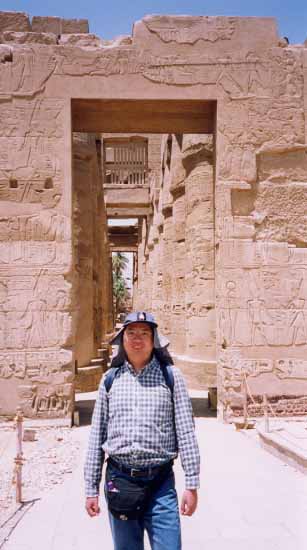
The outer walls of the Hypostyle Hall are covered with raised and sunk reliefs of battle scenes.
The scenes have long since lost their color that was painted and the outlines of the scenes have been blurred by the centuries of wind and sun.
Still we can clearly see pictures of the battle of Qadesh, an important battle fought in Palestine and Syria during the reign of Ramses II.
The Southern walls also have hieroglyphic texts recording details of the Hittite king and Ramses II signing a peace treaty.
This is the earliest formal diplomatic agreement ever recorded in history.
continued...
Back to Lighting
Back to top
Beyond the Third Pylon
Leaving the Hypostyle Hall through the Third Pylon, we came to a narrow court.
Here is the original entrance to the temple before the New Kingdom, and everything we have passed were built afterwards.
Hatshepsut, erected four obelisks here.
Each of the obelisks was 23 metres in height and 143 tons in weight.
Unfortunately only one of them is still standing.
A fifth one was being carved, but was abandonned because the stone cracked.
Egyptian obelisks were always carved from single pieces of stone, usually pink granite from the distant quarries at Aswan, several hundred kilometres South of Karnak.
Of the hundreds of obelisks that once stood in Egypt, only nine now stand; ten more lie broken, victims of conquerors, or of religious fanaticism of competing cults.
The rest are buried or have been carried away to foreign lands to dwell in the central parks and museum concourses of New York, Paris, Rome, Istanbul and other cities.
Beyond the four obelisks of Thutmosis I is the only remaining Obelisk of Hatshepsut.
It is much higher (30 meters of height) and weighs 320 tons.
The top of the obelisk was visible from 80 km away.
Besides the Lateran obelisk in Rome (which is 30.7 metres high), this is the tallest standing obelisk in the world.
An inscription at its base indicates that the work of cutting the monolith out of the quarry required seven months of labor.
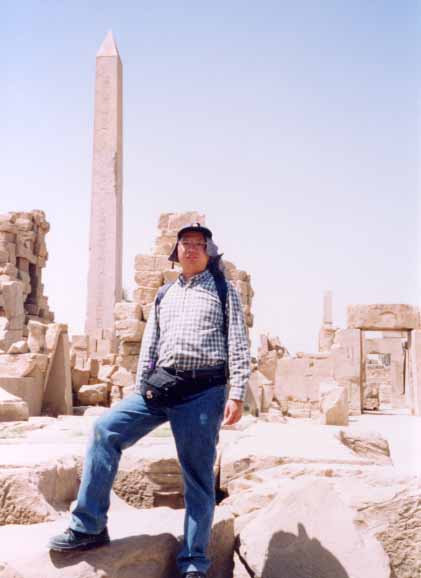
![]() When Tuthmosis III, the step-son and successor of Hatshepsut, came to power, the name and memory of Hatshepsut suffered systematic obliteration.
Hatshepsut raised four obelisks at Karnak but only this one is still standing upright.
Even so, Tuthmosis III built a high wall around her obelisk, hiding the lower two-thirds of it.
However, the upper part of the obelisk is still clearly visible from far away.
In the photo, you can clearly see the remains of the wall around her obelisk.
When Tuthmosis III, the step-son and successor of Hatshepsut, came to power, the name and memory of Hatshepsut suffered systematic obliteration.
Hatshepsut raised four obelisks at Karnak but only this one is still standing upright.
Even so, Tuthmosis III built a high wall around her obelisk, hiding the lower two-thirds of it.
However, the upper part of the obelisk is still clearly visible from far away.
In the photo, you can clearly see the remains of the wall around her obelisk.
continued...
Back to Reliefs
Back to top
Fourth Pylon and beyond
![]() Then we arrived at the Fourth Pylon, built by Tuthmosis I.
Then we arrived at the Fourth Pylon, built by Tuthmosis I.
Beyond the Fourth Pylon is the Transverse Hall, which is a narrow hall that formed the earliest part of the temple.
It contains 14 papyrus columns, plus two obelisks that were added by Hatshepsut.
![]() Behind the Transverse Hall is the Fifth Pylon also by Tuthmosis I.
Behind the Transverse Hall is the Fifth Pylon also by Tuthmosis I.
Looking back from the Fifth Pylon, we can see both obelisks and the ruins of the courtyard.
The Fifth Pylon leads to yet another smaller transverse hall.
The Sixth Pyron is built by Tuthmosis III.
It leads to Akh-Menu, which is also known as Hall of Annals, or “temple of millions of years”.
Inside of the hall are two rows of ten tall columns known as the “tent poles” with their shafts painted dark red to imitate wood,
They was figured from the wodden pole of the temporaly tent structures at festival, and bear a flat roof that is higher than the roofs of the surrounding halls.
It makes the higher openings between the roofs similar to clerestory in the Hypostyle Hall.
Surrounding the tent poles are thirty-two square pillars decorated with scenes.
In this area one finds two slender square pillars decorated in painted high relief.
The South pillar is decorated with lotus, the heraldic plant of Upper Egypt.
The Norht pillar is decoarated with papyrus symbolising Lower Egypt.
Beyond these pillars lies the oldest part of the temple — the Holy of Holies.
continued...
Back to Third Pylon
Back to top
Sacred Lake
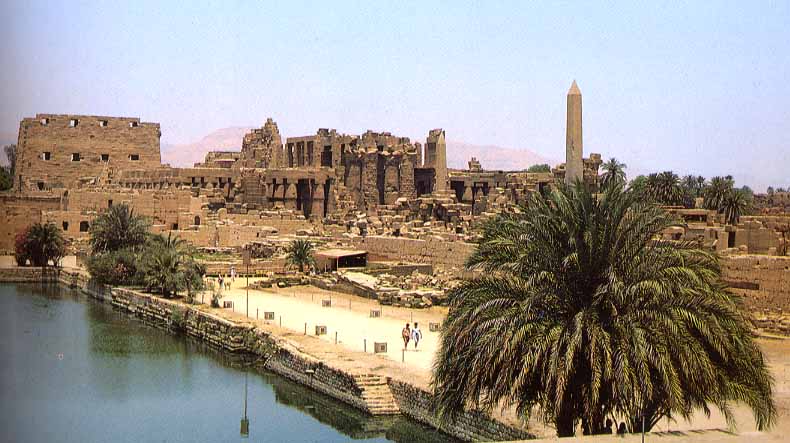
![]() On the southern side of the temple is the sacred lake.
It was fed by underground channels from the Nile.
On the southern side of the temple is the sacred lake.
It was fed by underground channels from the Nile.
All Egyptian temples had a sacred lake.
The lake of Karnak is the largest: 120 metres by 77 metres.
It is surrounded by buildings: storehouses, priests’ homes and even an aviary for aquatic birds.
In these waters the priests used to purify themselves every moning before starting their daily holy rituals.
It was also used during festivals when images of the gods would sail across it on golden barges.
continued...
Back to Fourth Pylon
Back to top
Temple of Luxor
After we left the Karnak Temple, we returned to the city of Luxor.
Our destination sits on the riverside among modern hotels and office buildings — the Luxor Temple.
The temple was dedicated to Amon-Ra, whose marriage to Mut was celebrated in the festival of Apet held around end of August.
The Temple at Luxor was founded on the site of a Middle Kingdom sanctuary.
It was substantially the work of Amenophis III of the 18th Dynasty.
A hundred years later, Ramses II of the 19th Dynasty added to the temple a great pylon, a porticoed courtyard, many huge statues and other constructions.
Ramses II was one of the most prolific builders of ancient Egypt.
Hardly a site exists that he did not initiate, add to, complete, or build entirely himself.
Unlike the Karnak Temple, the Luxor Temple was not enhanced by later pharaohs.
Like the Karnak Temple, many of the main roads that led to the Luxor Temple used to be continuously lined with ram-headed sphinxes.
During the New Kingdom however, many of the ram-headed sphinxes of the avenue were beheaded and replaced with human heads.
One of these avenues joint the Luxor Temple to the South Entrance of Karnak Temple (not the main entrance where the First Pylon is) by a long stone-paved processional avenue flanked by sphinxes (refer to map of Luxor by Mark Millmore).
During Apet, thirty priests carried the sacred boat of Amon-Ra from Karnak Temple along the processional avenue to Luxor Temple.
The boat is kept in the sanctuary for several days before returning to Karnak.
Thus Luxor Temple is also known as the Southern harem of Amon.
Most parts of the avenues are still buried under the (modern) Luxor city and is not yet completely reconstructed.
continued...
Back to Sacred Lake
Back to top
Avenue of Sphinxes
The avenue of sphinxes ended at the main entrance to the Luxor Temple, marked by a 24 metre high pylon erected by Ramses II.
It features a 65 metre wide front decorated with bas-reliefs illustrating scenes from the Battle of Qadesh where Ramses II defeated the Hittites.
There used to be two 25 metre high pink granite obelisks in front of the pylon.
The pyramidal tip of the shaft was covered in sheet gold which flashed in the sunlight, symbolizing the sungod Ra in his brilliance.
On the pedestal are carved the four sacred baboons who were the first to greet the morning sun.
Today, only the obelisk on the left remains in Egypt.
The obelisk used to stand on the right side was sent to Paris in 1833, and was erected in the Place de la Concorde of the Champs Élysees on 25 October 1836.
When the obelisk was lowered for shipment, the name of Ramses II was found inscribed on the bottom.
Pharaohs were notorious for usurping monuments built by earlier pharaohs, so Ramses II took precautions to make the obelisks remain his own.
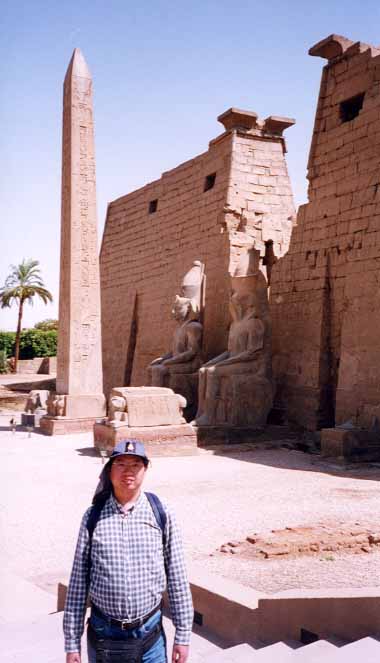
![]() Behind the obelisk are a pair of colossi of Ramses II in granite.
They are 15.5 metres of height sitting on a base of about one metre high.
Like the Colossi of Memnon, the colossi represent the pharaoh and his ka seating on his throne.
In ancient times, there were also two standing colossi in front of the pylon, but only one of them now remains.
Behind the obelisk are a pair of colossi of Ramses II in granite.
They are 15.5 metres of height sitting on a base of about one metre high.
Like the Colossi of Memnon, the colossi represent the pharaoh and his ka seating on his throne.
In ancient times, there were also two standing colossi in front of the pylon, but only one of them now remains.
continued...
Back to Temple of Luxor
Back to top
Courtyard of Ramses II
Having passed through the triumphal entrance, one enters the Courtyard of Ramses II, dedicated to the Theban triad, Amon, Mut (wife of Amon, refer to Mysteries of Egypt) and Khonsu (son of Amon and Mut, refer to Mysteries of Egypt) .
The walls of this court were decorated with scenes of the festival of Apet.
The Courtyard of Ramses II is not rectangular in shape, but is an oblique parallelogram.
The pylon and the Courtyard of Ramses II are directed towards the Karnak Temple instead of lying on the original axis of the Luxor Temple (refer to map at Tour Egypt).
![]()
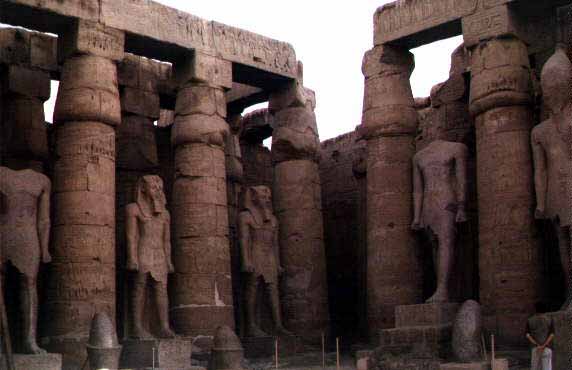
![]() Surrounding the courtyard are 74 well-proportioned columns in double rows.
The columns have with closed papyrus bud capitals, and on them are carved scenes of Ramses II before various gods.
Surrounding the courtyard are 74 well-proportioned columns in double rows.
The columns have with closed papyrus bud capitals, and on them are carved scenes of Ramses II before various gods.
Between the columns are statues of Osiris and Ramses II
continued...
Back to Avenue of Sphinxes
Back to top
The Mosque of Abu al-Haggag
The Arabic name of Luxor, “al-Uqsuur”, means palaces.
The city was a small Nile village famous only for the renowned 13th Century Sufi Shaykh Ynsuf Abu al-Hajjaj, who lived there for several years.
The Luxor Temple was buried deep beneath the streets and houses of the town of Luxor.
In the 19th century, the sand reached the shoulders of the statues at the temple entrance.
The Mosque of Sufi Shaykh Yusuf Abul al-Hajjaj was built above the location where the Courtyard of Ramses II was, and it was not until the Luxor Temple was excavated in the 1880s when French we discovered that the village indeed deserved its name.
When the Luxor Temple was unearthed, it was decided to leave the mosque intact.
It now becomes an integral part of the Luxor Temple, sitting on top of the North East walls of the Courtyard of Ramses II.
The minaret of the mosque can clearly been seen from inside the Courtyard of Ramses II.
Refer to photos by Mark Millmore.
continued...
Back to Courtyard of Ramses II
Back to top
The Colonnade of Amenophis III
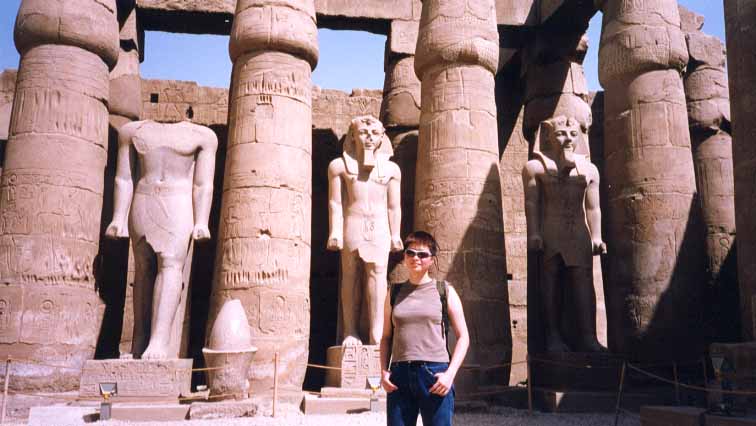
On the South side of the Courtyard of Ramses II are a pair of seated colossal statues of Ramses II.
Behind the statues are four smaller sitting statues, two on each side.
On the right are Ramses II and his wife Queen Nefertari; on the left are Amon and his wife Mut.
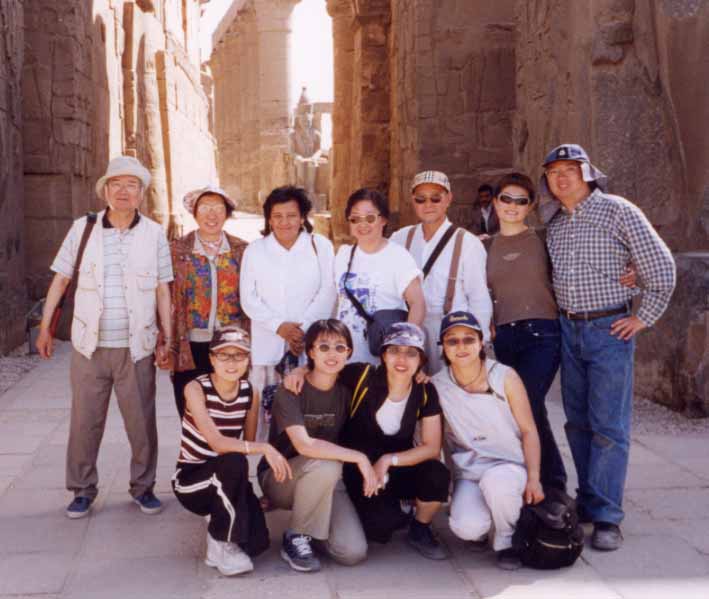
![]() Beyond the statues lies the 53 metre long processional colonnade of Amenophis III.
From our group potho taken at the entrance, you can see one of the colossal statues of Ramses II and behind it the Colonnade of Amenophis III.
Beyond the statues lies the 53 metre long processional colonnade of Amenophis III.
From our group potho taken at the entrance, you can see one of the colossal statues of Ramses II and behind it the Colonnade of Amenophis III.
The colonnade has seven pairs of 16 metre high open-flower papyrus columns, and serves as the entrance hall of the Courtyard of Amenophis III.
continued...
Back to Mosque of Abu al-Haggag
Back to top
The Courtyard of Amenophis III
![]() The Courtyard of Amenophis III measures 45 metres by 56 metres in size, and is considered one of the most perfect and notable examples of 18th Dynasty work.
It has double rows of columns on three sides.
The columns are nicely fascicled and have closed papyruses capitals, representing a real, highly evocative forest.
The elegance of these proportioned colonnades is unrivaled.
The Courtyard of Amenophis III measures 45 metres by 56 metres in size, and is considered one of the most perfect and notable examples of 18th Dynasty work.
It has double rows of columns on three sides.
The columns are nicely fascicled and have closed papyruses capitals, representing a real, highly evocative forest.
The elegance of these proportioned colonnades is unrivaled.
While the columns on the East and West sides of the court are well preserved, many of them on the North side are gone.
This forecourt was originally roofed over, unfortunately the blocks have perished as well.
continued...
Back to Colonnade of Amenophis III
Back to top
Beyond the Courtyard of Amenophis III
Beyond the Courtyard of Amenophis III is a hypostyle hall with four rows of eight columns having closed papyrus bud capitals.
Reliefs on the wall depict the coronation of Amenophis III before the gods.
The Hypostyle Hall leads to a series of antechambers with subsidiary rooms.
Besides the chapels dedicated to Mut and Khonsu, there is a chapel converted into a church by covering the reliefs of Amenophis III offering incense to Amon by Christian paintings.
The most interesting room is called the “Birth Room”.
It is decorated with a scene showing the divine birth of king Amenophis III.
In the picture, Amon is disguised as Tuthmosis IV (his father) and breathed the child (Amenophis III) into the nostrils of Queen Mutemuya (his mother).
So by these pictures, he claimed that he was the son of the god Amon.
Beyond the antechambers is the sanctuary where the sacred boat of Amon was stored during Apet.
continued...
Back to Courtyard of Amenophis III
Back to top
End of the Journey
Our trip to the Luxor Temple closes our journey.
After we returned to the Luxor city, most of our group went to join a Nile cruise.
Irene and I however preferred to rest a while, to wander in the streets of Luxor, and to enjoy some icecreams in a restaurant.
In the evening, we took a plane to fly back to Cairo, then back to Greece, and finally back to Istanbul.
continued...
Back to Antechambers
Back to top
Afterwards
Back in Istanbul, we learnt the bad news.
Cathay was on strike, and we happened to be taking Cathay because only Cathay offered direct flights between Hong Kong and Istanbul.
After some hard works from the tourist agent and the airlines, our whole group is changed to fly Unite Emirates.
It departs at a later hour and so we earned several hours of free time in Istanbul.
The flight had one hour delay but we were already used to delays after our trip to the airport of Athens.
The planes were comfortable as advertised, and it was a nice experience to be able to try different airlines in a single journey.
United Emirates however do not fly to Hong Kong directly, and we need to change flights at Dubai around midnight.
It was a hot and chaotic night at Dubai, and the ground crews had difficulties finding us on their name lists because we were holding Cathay tickets.
Fortunately all ends well and we were back to Hong Kong in one piece.
It took me half a year to author these web pages, but I am glad it is now completed as scheduled.
In their preparation I learnt much more of these countries than before.
Yet most important, writing these pages brings me the nice memories of the trip.
And I hope these pages will help me to keep them afresh for the years to come.
back to other pages...
Back to End of the Journey
Back to top